When a translated clinic review leaves a detail unclear
A short review can sound remarkably definite once it has been translated. Before you rely on a sentence about a doctor, procedure or result, find the original Google or Naver listing, identify the detail that matters to your decision, and ask whether the wording actually supplies it. You do not need to translate the whole page perfectly to plan a better consultation. You do need a more reliable source than a visitor’s translated phrase for questions about what a clinician will do to your own body.
Return to the whole account
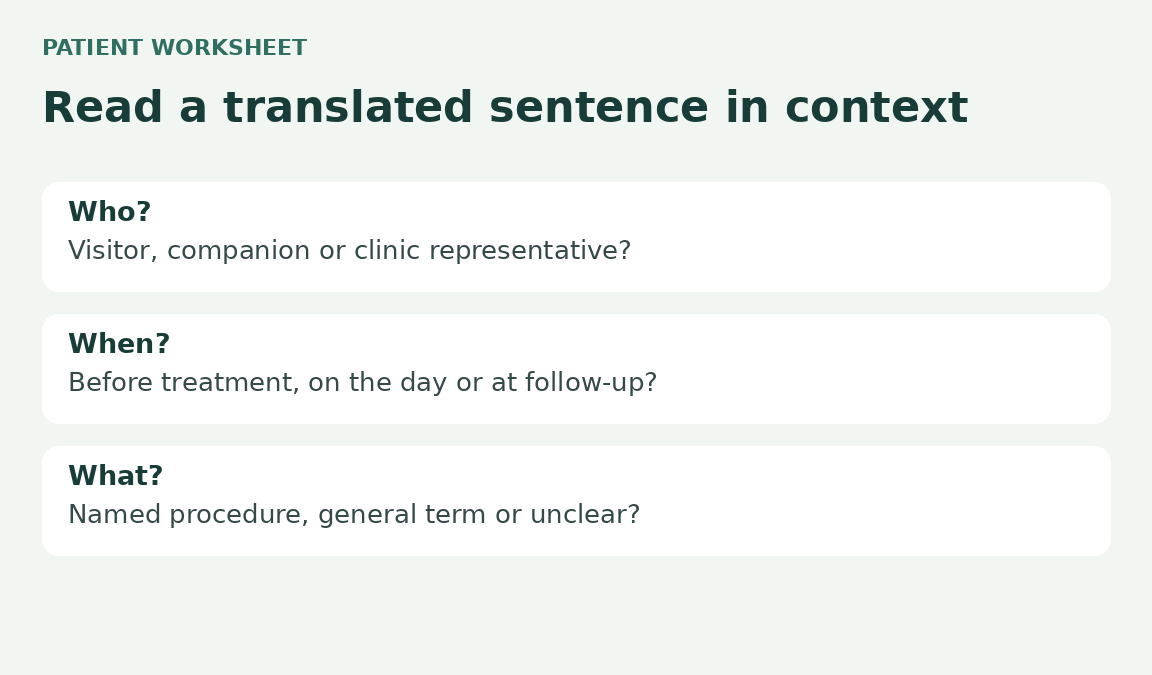
A friend sends you a sentence about an eye clinic and says it helped them decide where to book. Open the original source before deciding what it means for you. Look at the name of the place, the posting date and the surrounding lines. Check where the writer’s account ends and where a response from the business begins. A screenshot may show an enthusiastic final sentence while leaving out the fact that the writer had only attended an examination. A clinic representative’s own description of treatment is another person’s statement entirely.
The date on the interface may be the posting date. An account written after a trip can refer to an earlier visit. A phrase equivalent to “today” belongs to the person who wrote it at that time. If you cannot establish when the visit occurred, keep the date as unknown. Someone asking whether a doctor works at a clinic now needs a current answer from the clinic even when an older visitor clearly named that doctor.
If you can see the original text, keep it beside the translation while you read. On Google Maps, the help pages explain how language settings affect reviews. Available controls may vary with the device and language. If you can see only the translated version, make a note of that limitation. Using a second translation can bring an ambiguity to your attention. Agreement between two translations does not prove a particular procedure was performed.
Watch for a missing speaker
In short accounts it can be difficult to tell who explained something. A person might use a title translated as “teacher,” “director” or “doctor” without giving a name. The words surrounding it may tell you whether the person answered a question, examined the patient, or was present for treatment. If they do not, avoid supplying a job title or attributing the action to a named clinician from the clinic website. A team page tells you who is listed now. It does not identify the speaker in a particular conversation.
Instead, separate your notes into two sentences. In the first, describe only what you can reasonably tell from the text, such as that someone explained the test. In the second, write the question prompted by it, such as who interprets the measurements at your appointment. Keep the question even if you later discard the review. Its usefulness comes from what you need to understand, not from proving that another person’s visit looked a certain way.
When interpretation itself matters, identify the part of the visit that concerns you. A review that mentions a friendly English-speaking receptionist does not establish whether a clinician, interpreter or translated document was available during a consent discussion. Ask in which language your appointment can take place, who would interpret questions during the examination, and what happens if you need to speak with the clinic after you return home. Confirm these arrangements for the date you are considering.
A discount, a promotion, or payment for a review?
Suppose a translation says that “there was an event price.” It might refer to a temporary price available to all visitors. It does not by itself establish that a patient was rewarded for posting. Read the surrounding text for an explicit condition: did the person describe receiving something in exchange for leaving, changing or removing a review, or did the visit simply happen during a promotion? If the original does not settle this, label the relationship unknown.
Google Maps prohibits incentivized contributions, including reviews exchanged for discounts or free services. That policy identifies a specific concern. It does not license a reader to conclude that a post was purchased because it sounds enthusiastic, contains a translation error or repeats the name of a procedure. Apply the rules of the platform where the original appeared; Google’s policy does not describe how Naver evaluates an individual contribution.
If you need a reliable treatment price, ask the clinic for the terms that would apply to you in writing. Ask whether a price is contingent on public posting, consent to photography or any other condition. Keep that practical inquiry separate from any decision to report an individual review. If an original Google post expressly describes an exchange that appears to breach the policy, use the platform’s own reporting route without reposting patient details.
Did the reviewer have a procedure, or only discuss one?
When treatment stage matters, read the sentences immediately before and after the translated word. A visitor may describe receiving a quotation, reserving a date or being told that something could help. None of those events establishes that the treatment took place. A translation can hide the distinction if a subject is omitted or a short phrase reads like a completed action. Write down the event you can identify and leave the outcome field empty if no outcome was described.
Consider a hypothetical account about a lens consultation. The writer mentions measurements, a discussion of two lens options and an appointment next month. You can extract a useful question about who interprets the measurements. You cannot tell whether a lens was later implanted, which model was selected or what the person eventually saw. Contrast that with an account mentioning a postoperative review: that narrows the stage but still may not identify the exact procedure, diagnosis or clinician.
Before passing the story on, try writing two columns: “The account describes” and “I still need to ask.” Put a visit for measurements in the first column and the time needed for your own assessment in the second. If you need help with the original wording, ask a fluent reader to identify the action and its timing without naming the patient. For medical terminology or your own care plan, take the question directly to the clinic. A clearer translation cannot recover an event the author never reported.
Google Maps help for reading reviews in a different language
A broad treatment name can conceal several possibilities
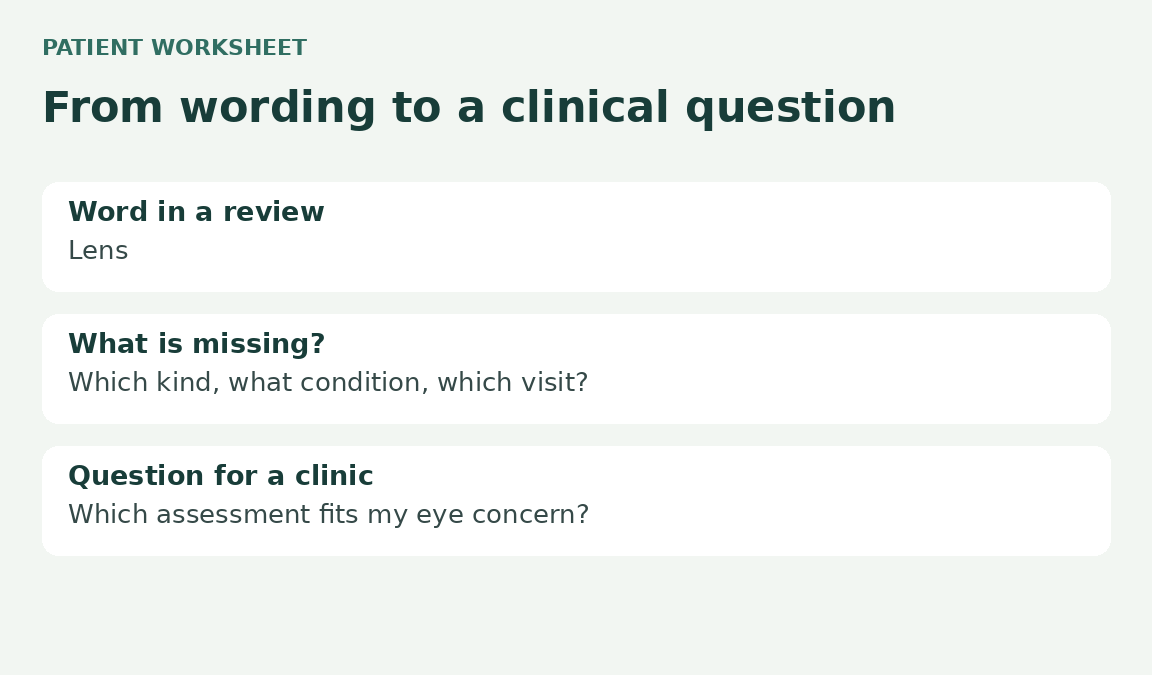
People often use a familiar shorthand when recounting an experience. An English rendering such as “laser” may refer to a category rather than a specific device or procedure. Similarly, a phrase about “the lens” may leave out whether the visitor was discussing a contact lens, a surgical implant, or an option mentioned during consultation. Context can narrow the possibilities. It cannot make an omitted brand, measurement or diagnosis appear.
Write down the general topic and resist the urge to search for whichever product sounds most likely. If your real question is whether your prescription or eye history makes you eligible for a procedure, the reviewer cannot answer it. Ask an eye clinic what assessment it uses to consider your options and who explains the results. That conversation can include alternatives, reasons to wait and the chance that the clinician advises against the procedure that first interested you.
A useful way to test your interpretation is to ask whether a different meaning would change anything you plan to do. If the word merely describes the waiting room, uncertainty may not matter very much. If it affects which treatment you think is offered or how long you believe recovery will take, leave it unresolved and get a direct answer. This lets you spend attention on the language that could actually affect consent, travel or follow-up.
Separate what happened from how the writer felt
Words translated as “comfortable,” “fine” or “easy” may refer to how staff spoke, the booking process, the examination, or how the writer felt at a particular point. Check which part of the account the word modifies. If the sentence does not say, do not turn it into a clinical outcome. For instance, a smooth arrival and a clear explanation can be valuable aspects of care even when there is no information about the person’s eventual vision or recovery.
One description of pain is especially hard to generalize. A reviewer may choose a mild expression, use humor or compare the experience with something that is unfamiliar to the reader. Even a precise translation would still describe one person. A more useful question for a clinician is what sensations people may experience during the specific assessment or procedure being discussed, what can be done if you are uncomfortable, and how to contact the team about later symptoms.
If translated wording sounds unexpectedly harsh or unusually absolute, pause before circulating it. Look for whether the statement is attributed to a visitor, the platform or the clinic. Keep the original link for your own comparison. You generally do not need a stranger’s photograph or identifying details to ask a clinic about its current practice. You can raise the practical question without accusing anyone of something the text may not say.
Find the stage of care
Look for a sequence. Did the person ask a question, attend an examination, agree to treatment, receive it and return for follow-up? These are separate events. A translation may collapse several into a single expression like “got it done,” or leave out the subject of a sentence. If the rest of the account describes an estimate and a future appointment, treat it as an account about planning unless the writer clearly says otherwise.
Ask yourself whether the time frame makes sense for the information you want. A visitor who just left an appointment might tell you whether written instructions were provided. They cannot use that visit alone to tell you how accessible help will be weeks later in another country. Someone writing later may discuss follow-up but omit how their original treatment was selected. Each account can help build a list of questions without giving you a complete picture of the course of care.
A photo beside the account rarely settles these uncertainties. It may show a corridor or a printed form without revealing what was discussed. A picture of a person after treatment cannot establish their diagnosis, consent discussion, timeline or final outcome. If the image has been detached from the review, avoid assigning it to a doctor or branch based on appearance alone. For a clinical question, go back to the service information and ask for an explanation of the plan relevant to you.
A listed eye clinic for questions about terminology
Ace Eye Center appears in the ReviewsKorea directory. Its international site describes separate cataract and vision correction services, making it a practical place to clarify which service a term refers to if you are considering an eye assessment there. Use the international website to describe your concern in your own words and ask what kind of appointment would address it. Explain whether you are asking about an examination only or considering a procedure. The reason to contact this clinic here is the specific service information it provides. No visitor’s reported result is being attributed to it.
Ace Eye Center profile · Ace Eye Center international website.
Keep a short translation worksheet
For each useful account, save the source link and the name of the matched branch. On a second line, write the part of the visit the account clearly describes. Next, write the word or phrase whose interpretation matters, and record what is missing. Finish with one question for the clinic. “Does this word refer to an examination or a procedure?” is easier to answer than a request for a general verdict on a stranger’s experience.
If you ask someone you trust to read the original, explain why you are asking. A fluent speaker may be able to identify the tone or subject of a sentence while remaining unable to tell you what a medical abbreviation means. A clinician can explain a treatment term without knowing which service a reviewer received. Keep those two contributions separate. If the original never specifies the answer, a good translation can leave the question open.
Should I discard every translated review? You can use translated accounts to identify recurring practical questions, such as how appointments are arranged or whether people received written directions. Read several original listings where accessible and treat the wording as one input. For arrangements that you will rely on, get confirmation from the branch itself.
What should I take to the consultation? Take the questions you extracted, together with your own medical history and goals. You usually do not need to show the reviewer’s entire account. A concise question gives the clinician room to explain how the options apply to you and to correct a misunderstanding before you commit to a treatment or a travel date.
Google Maps review help · FTC guidance on evaluating online reviews.