A private follow-up or a public clinic review? How to choose the right conversation
If you need an answer about your own care, contact a clinician through the clinic’s designated private channel. If you want other patients to understand a visit you have already had, a public review can describe that experience without disclosing your medical record. Some visits leave you wanting to do both. It is easier to write clearly, and protect your privacy, if you prepare two separate messages with different readers and purposes.
Decide what needs to happen next
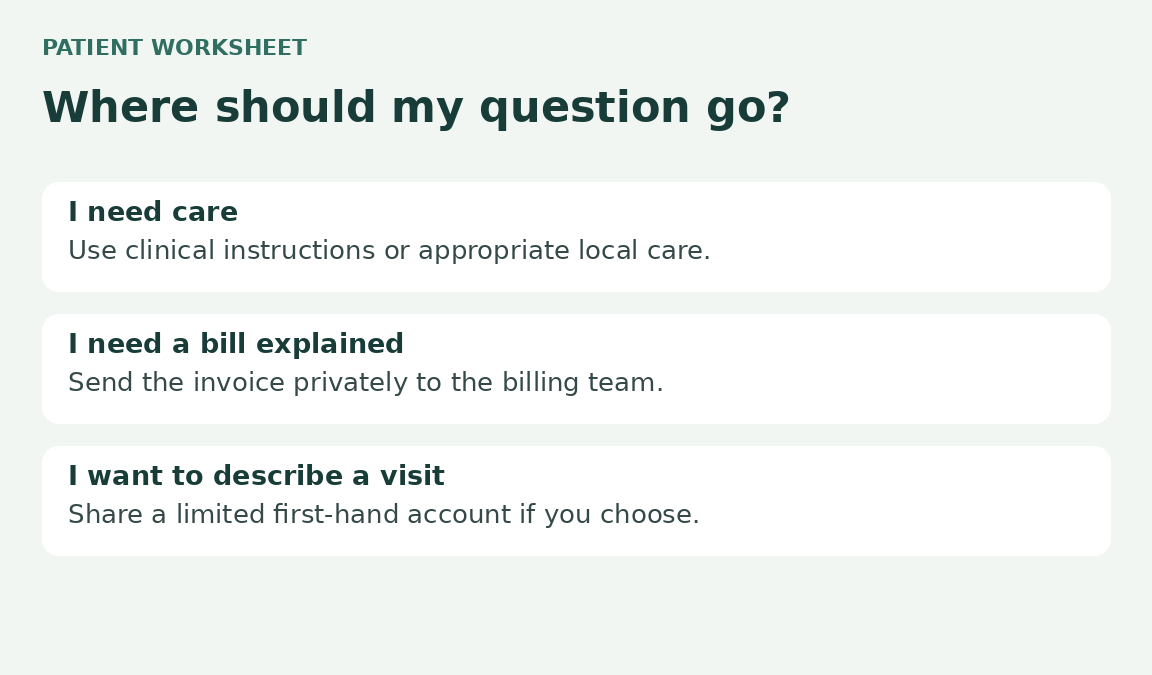
Finish this sentence before opening a review page. “I need someone to …” If your answer is “explain my report,” “call me about a symptom,” “confirm the follow-up appointment” or “correct the charge on my invoice,” you need an identifiable team to respond. A public post could be overlooked, answered by someone outside your care team or replied to after your deadline. Send the request to the appropriate private service and keep a copy. Seek local urgent or emergency care for an urgent medical concern rather than waiting for a clinic overseas to respond online.
If your answer is “help another visitor prepare,” think about the particular moment you can describe first hand. Maybe the appointment letter named a building but left the floor unclear. Perhaps you received written instructions in a language you could read. Or the estimate arrived only after you asked what it included. These are observations you can explain without disclosing test results, speculating about the clinic’s intentions or predicting how a different patient’s treatment would go.
If both motives apply, give the care question priority. A person who is still waiting for an explanation need not decide immediately how to characterize the whole experience. Save a private note recording the order of events. When you have more information, you can decide whether to write publicly and which parts of the story would help someone else. A review is optional. Obtaining appropriate care and understanding what was agreed are more immediate needs.
Route medical, billing and practical questions separately
A medical question generally needs enough context for the clinician to understand which visit and plan you mean. Use the secure method the clinic gives you. Ask what identifying details it requires before sending records, photographs or results. A public comments box, an email address copied from a stranger’s post and a private clinical portal are different ways of communicating. Confirm the private route from the clinic’s official international site or your own discharge documents.
A billing question may need an itemized estimate, a payment receipt and the section of the invoice you do not understand. It usually does not require an entire medical history. Ask the billing team to explain the charge in writing and tell you which services or visits it covers. If the team needs a reference number, send it privately. A receipt can contain your name, payment details or appointment identifiers even when it looks like an ordinary piece of paper.
An access question may be simpler. You could ask which entrance has a lift, where a taxi should stop or how to reach reception from inside the building. For these questions, the date, branch and type of appointment may be enough. You do not need to tell a public audience why you are being seen. If you need interpretation or another arrangement for a private examination, ask when and how the clinic will confirm it specifically for you.
What if a public response identifies you or discloses a medical detail?
You may have written a brief account without naming your procedure, only to find that a public reply adds a date, a full name or information about your treatment. First note where the information is actually visible. Is it in your own review, a photo you uploaded, the clinic’s response or a different person’s post? Changing text that you wrote may not remove information written by someone else.
If you want to keep a record of what appeared, save the original link and a private copy containing only the context you need. Avoid posting another screenshot to draw attention to it; that can spread the very detail you want removed. Contact the clinic privately through a verified channel. Identify the listing and the exact item you want reviewed, without sending a full medical file. You might say, “The public response to my review includes identifying information. Please remove that detail and contact me privately about my visit.”
On Google Maps, the published content policy addresses personal information, including medical information, and the platform reviews reports under its own rules. If you report content, distinguish a privacy concern from disagreement with someone’s opinion. Do not assume a report has removed an item until you check the original listing. If an unresolved question about results or treatment prompted the review, contact your care team separately so the medical issue does not wait for platform moderation.
How to correct your public account after the clinic replies
Suppose you wrote that you had not received your test report by the date you expected. The next day, the clinic sends the document and a doctor explains it. Those two experiences belong at different points in time. If you want to update your account, you can describe the original communication gap and add when it was resolved. You can say that you received a private explanation without repeating a diagnosis or uploading the report.
First open the review on the platform where you actually posted it. An account you wrote on Google, a Naver visitor review and a submission on a directory are separate records. Changing text in one place does not establish that it changed elsewhere. If someone shared your review as a screenshot, the screenshot can still contain the old version. Keep sensitive information out of the replacement text as well as any new photo.
For a correction about an invoice, compare the earlier written estimate with the final response in private. In public, limit the update to the point you can verify, such as receiving a breakdown of a charge. If a clinical question is still unanswered, keep it on the private follow-up list and contact the clinician responsible. Editing a star rating or adding an update is a decision about your public account. It does not acknowledge receipt of medical results to a care team or schedule the next appointment.
Google Maps instructions for editing or deleting your own review
Write the private message so the team can act
Open with the request, then add only the context that explains it. For example, you can say that you attended a consultation last week, received a report through the clinic’s portal and need to know who will discuss it with you. Ask for the next step and how you should arrange it. If you are leaving the country soon, explain that practical constraint. A clear departure date can help the team propose a realistic way of communicating without implying that waiting is medically appropriate.
For a question about a procedure you already had, use the contact instructions your treating team provided. If those instructions do not cover your situation, ask which service is responsible now. Save the answer and any deadline the team gives you. Sending the same sensitive information through several unverified accounts creates extra exposure without ensuring it gets to a clinician. Do not rely on a directory or a social-media moderator to triage symptoms.
For an administrative disagreement, state what the documents say and what you want clarified. “My estimate lists two appointments and my confirmation shows one. Would you confirm which visits are included?” gives someone a concrete task. Preserve the full evidence for a private discussion or a formal process if one becomes necessary. There is no need to publish bank details or an unedited invoice to explain publicly that you had to ask about the scope of a quote.
Choose what belongs in a public account
Start with the stage of care. “I attended an initial consultation” establishes a different vantage point from “I returned for a planned follow-up.” Next, describe an event that you personally experienced. Mention the branch when that information helps readers identify the right place. Give enough timing information to distinguish the initial visit from a later one. Consider whether a month or general interval will serve the reader as well as an exact appointment date.
Keep a distinction between what you saw and what you understood it to mean. If you did not receive a written copy of a plan during the visit, you can say exactly that. If it was sent the following day, that detail makes the sequence clearer. You may not know whether the delay arose from translation, a staffing problem or a routine process. There is no need to supply an explanation you cannot verify to make the experience informative.
Give the reader one question they could take away. An account about receiving an estimate might end by suggesting that others ask when an itemized version will arrive. You can explain which language you used with reception while leaving open whether a clinician or interpreter is available to someone else on another day. This makes a review useful to a wider group of patients without pretending your visit establishes the clinic’s usual practice or quality of care.
Read the draft once for other people’s privacy
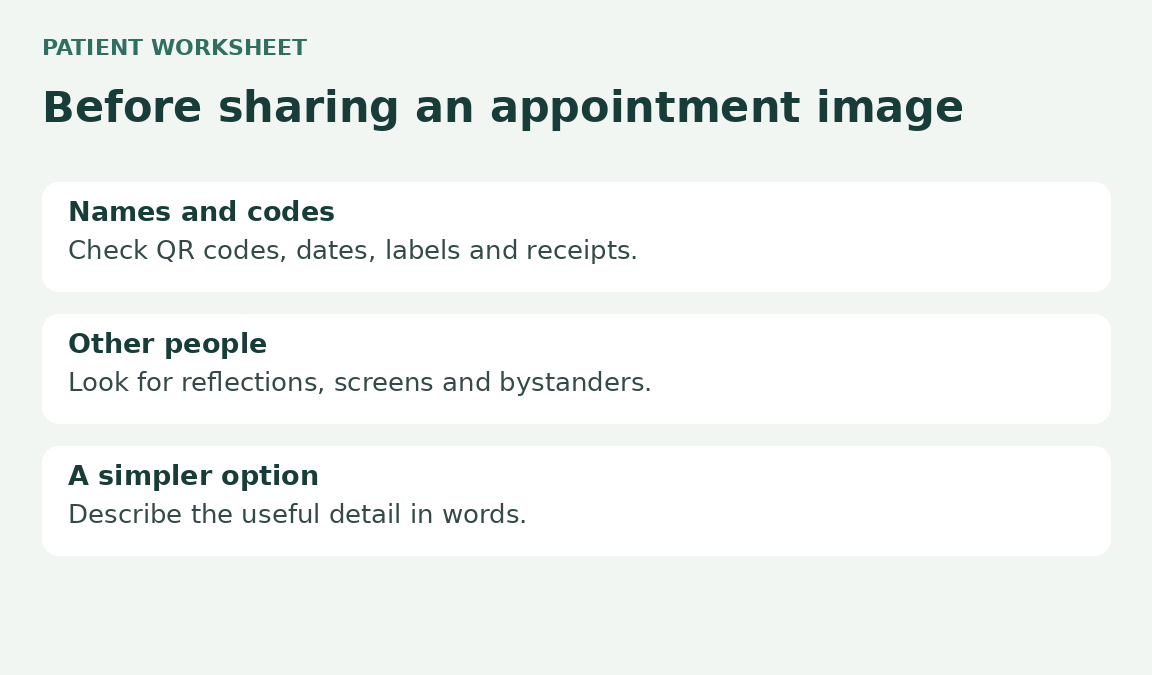
Waiting rooms, reception desks and group recovery areas can include people who never agreed to appear in someone else’s post. A photograph of a door might also capture a patient name on a sign, a staff screen or a reflection in glass. Before sharing a picture, ask what it adds. A written note explaining how you found the entrance can often do the same work with much less risk. You can leave a photo out even if the platform makes it easy to attach.
An appointment card can show both personal identifiers and a pattern that makes the visit easy to recognize. A clinic wristband, QR code, prescription label, invoice, booking reference or screenshot of a message thread may expose more than you intended. Reading the image on a larger screen can reveal information you missed on a phone. If you need a document to resolve a dispute, keep the original intact for the private conversation. You do not have to publish a cropped version as proof.
Consider your own future privacy as well. A username may link to other posts about work, family or travel. A rare procedure combined with a date and location can identify you even if your name is absent. Ask yourself whether you would still be comfortable with the information if someone who knows you came across it later. You can be truthful and specific about communication, waiting or follow-up without describing intimate examinations, fertility plans or a diagnosis.
A clinic contact for a sensitive appointment
Second Spring Women’s Clinic is listed on ReviewsKorea. Its international website describes gynecologic consultations, contraception and menopause services. If you are considering a visit there, use its official contact page to ask which private channel the team uses for records or test-result questions and who will respond. That route fits the sensitivity of the discussion. A publicly visible review should never be the only place a clinician could learn that a patient needs a result explained.
Second Spring Women’s Clinic profile · Official international clinic website.
If something changes after you write
A later reply may answer a question that was unresolved at the time of your visit. If you choose to update a review, distinguish the initial experience from what happened later. Both can be true. You might explain that a written explanation arrived after you contacted the billing team, without uploading the invoice or identifying the individual who responded. Google Maps offers guidance for editing or deleting a review from your own account. Check the controls of the original platform before assuming changes made elsewhere will update that account.
If you spot personal information in something you posted, return to the source where you published it. Look for editing, removal and reporting controls. Removing sensitive text from one post does not guarantee that every copy or screenshot elsewhere disappears. Think through that possibility before posting a document or a detailed photograph. A screenshot sent solely to a trusted clinical team through an approved channel has a different audience from an image attached to a map listing.
Can I write about a consultation where I went ahead with no treatment? Yes, you can describe the part you experienced and make its limits clear. Your account may help another patient ask whether a first appointment includes time for questions or a written plan. You can leave the clinical outcome out because no treatment occurred.
What if I cannot yet put the experience into words? Keep a private chronology with your appointment confirmation and questions. You can revisit it later, or choose to leave it private. A clear request to the right person today often matters more than a comprehensive public account. If you later write for other patients, a short, accurate observation can be more useful than publishing a complete medical history.
Google Maps guidance on editing reviews · ReviewsKorea review standards.