Which clinic branch did that review describe?
Before you put a Seoul clinic on your shortlist, check the address attached to the review and the address on the appointment offer. Two clinics can share a brand, advertise a similar treatment and have separate staff, appointments and review histories. A branch name in English may also appear in several spellings. The most useful comparison starts with a particular visit at a particular place. You can do that check without deciding whether the reviewer liked their treatment or whether a clinic deserves its stars.
Start with the appointment you actually want
Write down the reason for your visit in your own words. “I want a consultation about acne marks before choosing a treatment” gives you a clearer starting point than a device name copied from an advertisement. Beside it, write the neighborhood where you expect to visit and whether you need the appointment in a particular language. Those details give you a way to decide which reviews have something to do with your trip. A thoughtful account about reception at another location may be worth reading, but it answers a different question.
Next, open the provider’s own international website. Look for the branch name in the contact details and the street address at the end of the page. Save the address as written, including the floor or suite where one is supplied. Keep the website address with it. A search result or social-media post can lead to a brand’s main office when the consultation you have been offered takes place elsewhere. If you have received a booking link, compare that confirmation with the contact page.
Ask the clinic to send you the Korean address as well as an English rendering. Forwarding the Korean text can be easier than typing a district or street name from memory. If a map pin appears around the corner from the written entrance, ask which entrance to use. That practical difference need not invalidate a review. It is simply a reason to check. Two different street numbers or two different districts need a more definite answer before you treat the listings as a match.
Follow the review back to its listing
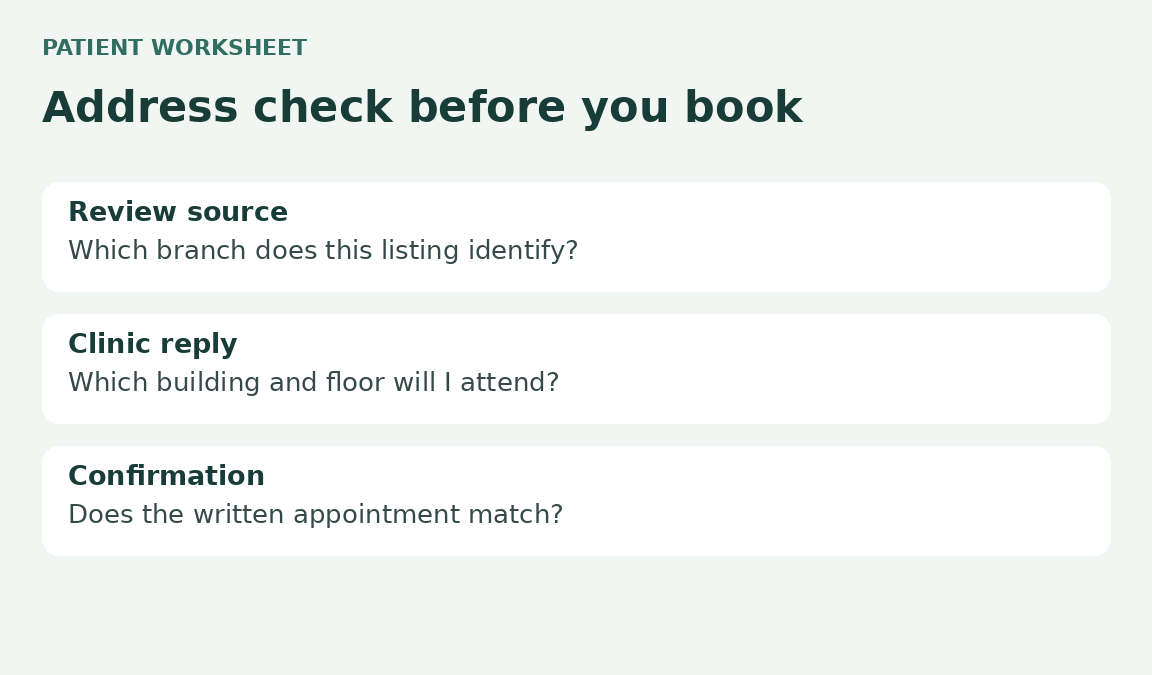
Start from the clinic’s profile on ReviewsKorea. Open the linked Google or Naver review source, then look at the location information belonging to that place. Check the branch label, street address and, where available, the clinic’s own website. A shared logo is a weak identifier. The city “Seoul” is too broad to settle most branch questions. If you can match the neighborhood and street address, record those matches. If one source omits the floor number, write “floor not shown” rather than filling it in yourself.
Look at who wrote the text you are reading. A business’s reply below a review can include the clinic name, but the reply and the visitor’s account are two different things. A directory introduction is different again. If someone shares a cropped image of an exchange with you, ask for the original listing. It can be impossible to tell from a screenshot whether all of the text belongs to one visit, whether it is still public, or which branch was selected.
If a source asks you to sign in or will not open, keep the original address and mark the evidence unavailable to you. The fact that you cannot read the text does not show that the patient never attended. It also does not give you enough to confirm what happened. Try the other eligible review source for the same branch if one is listed. Leave a blank where a match remains unresolved. Guessing which nearby clinic “must” be the one creates more confusion than admitting you could not tell.
Why two branch ratings cannot tell you which doctor is right for you
Once the addresses match, you may still see different numbers on a Google listing, a Naver page and a directory profile. First identify what each number counts. Google describes its place score as the average of ratings published on Google for that place. A set of selected written highlights on ReviewsKorea answers a different question. Even when both refer to the same branch, the people and time periods represented may differ.
Consider two hypothetical branches. One has many ratings from visitors over several years; the other has fewer reviews, some about appointments this month. A small gap between the displayed stars does not tell you which clinic has better surgical results, who will see you or how either team handles complications. You also cannot recover the proportion of visitors who needed follow-up by counting mentions in a handful of highlighted texts. Keep the two sources and dates on separate lines in your notes.
Choose a practical detail that matters to your visit, such as whether a clinician will explain examination results in your preferred language. Can you find an account that clearly describes that step at the correct branch? Use it to frame a question, then ask the clinic directly what it can arrange on your date. If no relevant account is visible, write “not established.” A numerical comparison cannot supply that missing information.
The map pin and your appointment disagree. Which address should you use?
Imagine your booking names a clinic on the seventh floor of a building, while the map opens at its ground-floor retail entrance. Those details can coexist. Now imagine the map names the same brand in an entirely different district. That is a different problem. Start by distinguishing the building entrance, the floor within the building and the branch itself. Save the Korean street address and ask reception which entrance serves the clinic. Pin locations alone cannot resolve all three details.
When the discrepancy matters, send one private message to the booking team with the two addresses written on separate lines. Say where each came from, identify the appointment date and ask which one is the place where you will see the treating clinician. Ask whether a later procedure or follow-up is elsewhere. Keep the written answer with the original confirmation. This gives you something precise to show a taxi driver or reception desk without exposing your appointment reference in a public map correction.
If the clinic confirms an official map listing is inaccurate, an edit to that listing and a change to your appointment are separate actions. Google Maps provides a way to suggest corrections to a place or pin. Submitting an edit does not move a booking. Keep using the direct instructions from the confirmed clinic and let the map service assess the public correction. If the clinic cannot reconcile two different branches, pause before paying or travelling to one of them.
What to do with a possible move or name change
You might find the same Korean clinic name attached to two addresses. Several explanations are possible. For example, a clinic may have moved, an old page may still circulate, or separate branches might use similar names. The first question is where your own visit will take place. The second is whether the experience you read describes that location and the current service. They do not have to have the same answer.
Send the two addresses privately to the clinic and ask when each was in use. Ask whether your clinician sees patients at that address. If the clinic says it relocated, ask whether there is an official notice or an updated contact page you can keep with your trip documents. The explanation may resolve where to go while leaving open whether the same people or arrangements were in place when the review was written. Keep the earlier review in a separate part of your notes if so.
A business can also use one location for inquiries and another for care. Check whether the initial visit, treatment and follow-up would happen in one place. If any appointment moves, ask for its address and on-site contact in writing. You may discover that a detailed review of check-in describes the building you will use only for a first meeting. That can still help you find the door. It tells you much less about a different clinic’s treatment arrangements.
A worked comparison using two listed branches
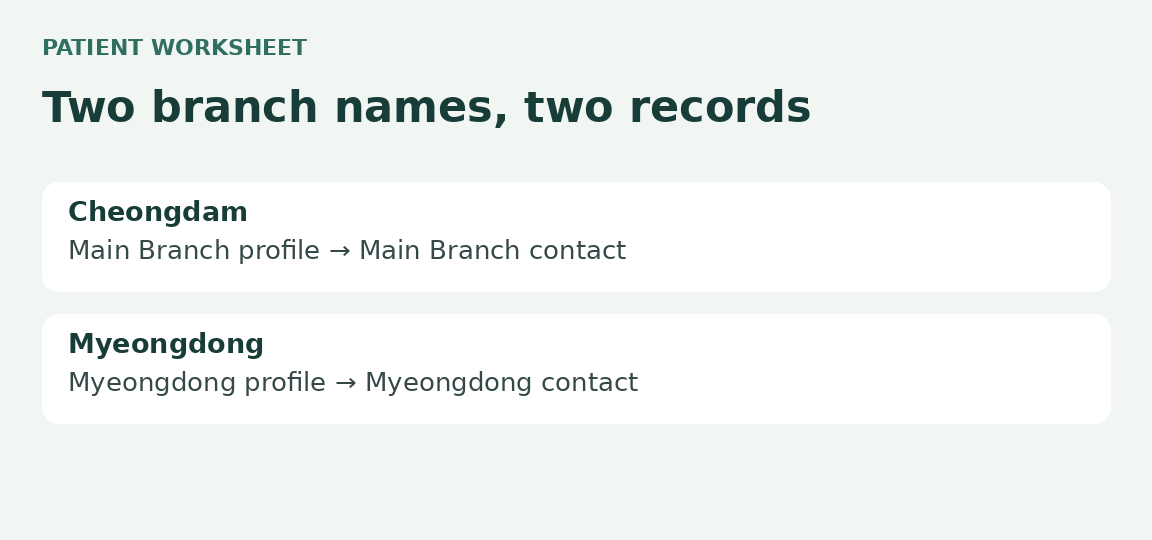
ReviewsKorea has separate profiles for BLS Clinic Main Branch and BLS Clinic Myeongdong. Their profiles point to different international websites and different Naver place records. Start two entries on your shortlist. At the top of each, put the branch name and the corresponding official link. Keep review source links inside the matching entry. Combining the entries under one heading called “BLS” would hide the very distinction you need when asking for an appointment.
Suppose your appointment message names Myeongdong and the link a friend sent opens the Main Branch. You have already found a meaningful difference. Ask your friend whether the link was meant to identify the brand or the place they visited. Ask the booking team which branch is printed on your confirmation. There is no need to interpret the friend’s experience as a complaint or endorsement of the branch you plan to attend. The immediate issue is simply that the two addresses have not been matched.
If both places offer the type of consultation you want, compare them as separate options. Ask each what happens at the first visit, who will assess you, what information to bring and how an interpreter would be arranged if needed. Record the actual reply from each clinic under its own name. A statement on one website about available services or support should not get copied into the other entry. This is useful even if the same person helps answer both inquiries.
Keep the doctor and the treatment in view
A branch match answers only the location question. A review may describe a different doctor, a different reason for attending, or a visit confined to an estimate. If no doctor is named, leave the doctor field blank. If the review names someone, compare the name with the clinic’s current team page and ask who is scheduled to see you. Names can be written in different orders or romanized in different ways. A similar surname alone does not establish an identity.
For treatments that take place over several visits, ask which part of the experience a reviewer describes. Someone may be able to explain how easy it was to find the clinic and speak with reception after just one visit. They cannot describe a later appointment they have not attended. Read the account for the questions it can help you ask. Avoid turning statements about politeness, speed or convenience into an estimate of whether a medical procedure would be appropriate for you.
If you need a particular type of examination or follow-up, ask how the clinic handles it for international visitors at the specific branch. You can ask for an assessment and decline to reserve treatment at the same time. If the reply provides a fixed package before anyone has discussed your concern, ask what would happen if the clinician recommends a different plan or no procedure. A review cannot settle the terms of your own appointment.
Where to check before requesting a visit
For a skin consultation in Cheongdam, ReviewsKorea lists BLS Clinic Main Branch. Its international website identifies the Cheongdam location and describes skin and laser services. Review that branch’s contact information and ask whether your concern fits its consultation service. For an appointment identified as Myeongdong, open the Myeongdong profile separately and use its own international contact link. This pair illustrates branch matching. Their inclusion here does not establish which one is clinically appropriate for you.
Main Branch profile · Main Branch international website · Myeongdong profile · Myeongdong international website
Questions to settle before you travel
What if I already paid a deposit to a different branch? Keep the original receipt and ask the clinic named on it which appointment and address it covers. Ask for any transfer, cancellation or refund terms that apply to your actual booking. Save the response. Do not assume from another patient’s account that a deposit transfers between branches. If you need time to understand the terms, ask when a decision is required and who can explain them in your preferred language.
Does a large review count make a branch easier to verify? A large number does not solve an address mismatch. Nor does it tell you how many reviews concern the doctor or treatment you are considering. A clear location match, a relevant account you can read at its source and written answers from that specific clinic are more informative for planning your next inquiry than an impressive number belonging to another branch.
What should I put in my final confirmation message? Name the branch, visit date, Korean street address and, if provided, floor and clinician. State whether you are attending for consultation alone. Include any language arrangements you have agreed, and ask for the contact to use if you arrive at the building and cannot find reception. This leaves you with a short message you can show on arrival and a clear account of what the clinic has actually confirmed.
How ReviewsKorea selects review sources · FTC guidance on evaluating online reviews.